
A couple of years ago, the expression “VWCE and chill” echoed among the fans of one-fund portfolios.
While I never liked the approach due to its high TER (relative to replicating a similar allocation), now there are cheaper alternatives.
In my opinion, WEBN is the strongest contender to take the throne of achieving global diversification with a single ETF.
What is WEBN?
Ticker symbols: WEBN, WEBQ; ISIN: IE0003XJA0J9
WEBN (Amundi Prime All Country World UCITS ETF Acc) is an ETF tracking the Solactive GBS Global Markets Large & Mid Cap index.
As described in the Solactive website:
The index intends to track the performance of the large and mid cap segment covering approximately the largest 85% of the free-float market capitalization in the Global Markets.
Basically, it’s a market cap-weighted index tracking both developed and emerging markets, providing a high-coverage global diversification.
WEBN is an accumulating ETF (it reinvests the dividends instead of distributing them to investors) with a TER (total expense ratio or yearly fee) of 0.07%.
In summary, it’s a great option for a one-fund, set-and-forget portfolio that rebalances itself and requires 0 nurturing in the long run.
WEBN vs VWCE
Let’s address the elephant in the room:
Why WEBN instead of other globally diversified ETFs, such as VWCE?
One word (or 3 words, depends how you look at it):
TER
- WEBN’s TER is 0.07%
- VWCE’s TER is 0.19% (lowered recently from 0.22% – I critiqued that a lot while European investors loved it)
The difference is large enough to disregard all other metrics.
But let’s entertain some of them:
Beyond the TER – Indices Tracked
First thing first: VWCE tracks the FTSE All-World index and WEBN tracks the Solactive GBS Global Markets Large & Mid Cap index.
So this is the first filter – whether you’re happy tracking Solactive’s global index rather than FTSE’s.
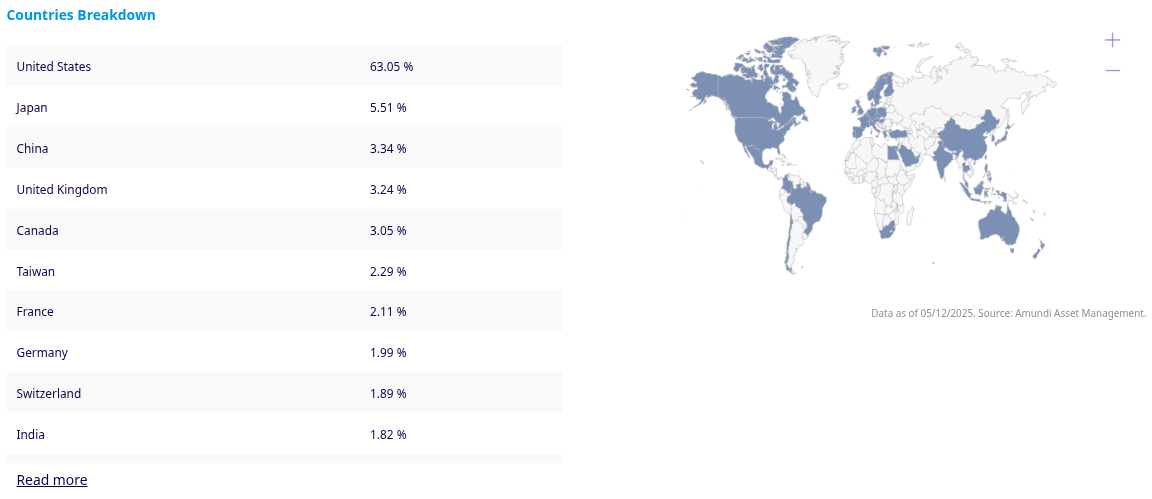
In terms of the ETFs, the global distribution and company allocations are quite similar. For example, here’s WEBN’s geographical coverage breakdown:
And here’s VWCE’s geographical distribution as of time of writing:
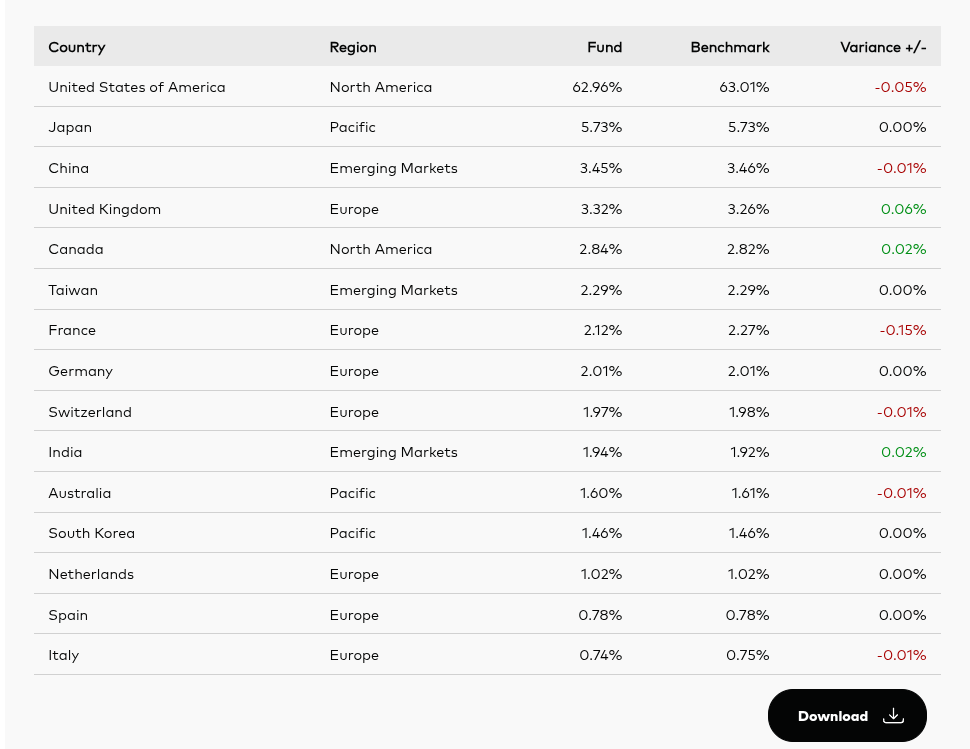
As you can see, they’re very close to each other.
The same can be said for the allocation per company, as it can be seen in the Amundi’s page and Vanguard’s page of the respective ETFs.
Beyond the TER – Tracking Difference
Let me preface this by saying that comparing tracking differences for funds tracking different indices is a meaningless exercise.
We will still do it, but I wanted to get that out of the way.
WEBN is too young to conclude about Amundi’s capability of achieving near-zero tracking difference.
One can be hopeful that this will be achieved because they’re doing a full replication of the index (which tracks 85% of the target markets), while VWCE does sampling replication of FTSE All-World (tracking 3622 of 4252 companies), which also roughly translates into 85% of the investable market.
But besides VWCE’s sampling approach, Vanguard still achieves a perfect tracking difference against FTSE All-World.
Amundi’s WEBN is yet to prove that it can do it on ongoing basis. But based on the ETFs’ respective expense ratios of 0.19% and 0.07%, there’s a ~0.12% room for error (ignoring internal transaction costs) until TD itself makes this conclusive.
But again, comparing tracking differences would make more sense if the two ETFs were otherwise identical.
And I’m sure Europeans will benefit from more global trackers going forward, each competing for a share of the market pushing the costs further.
But at this point, I prefer WEBN to the other ETFs suitable for a one-fund strategy.
Other Options?
There are plenty of other ETFs to achieve a market cap-weighted global diversification – FWRA, SPYY, IWDA, etc.
As a homework, try to figure out which of these might be contenders for a best global ETF for your portfolio.
Hints:
- Check which indices they’re tracking and how they differ from each other
- Compare their annual fees (TER)
- Compare the tracking differences of each against the index it aims to track
- Compare the tracking differences of ETFs tracking the same index
- Analyze the providers pages/prospectus in detail
If you’re a beginner, going through this process alone will make you a better analyst then most index investors.
PS While I’m not a one-fund portfolio type of investor, WEBN would be my ETF of choice if I ever decide to go that route.
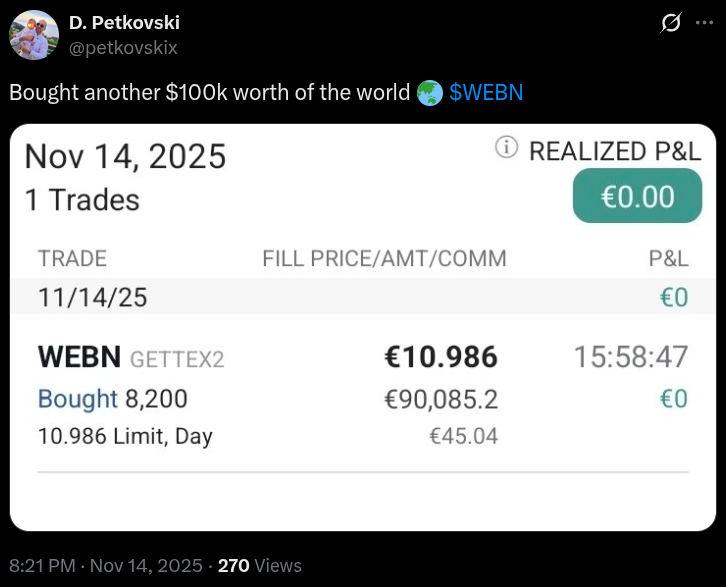
Still, I liked the ETF enough to invest ~$100k in it in November 2025, and shared it publicly:
And as I shift from accumulation to protection mode in the future, diversification would make more sense than concentration (i.e. what I was doing so far to outperform common benchmarks/indices).
But more on my personal investment strategies in later posts.
Author
-

D. Petkovski
📓 The Author Husband & Father
Software Engineer StrengthCentric
 ₿itcoin Hodler Long-Term Investor
🌍 Everything Enthusiast 🔥 Optimist

 Husband & Father
  Software Engineer


Related posts:
 Rebalancing – Managing Your Investment Portfolio
 Core Stock Portfolio for EU Investors (ETF Selection & Tips)
 Total Expense Ratio – The Importance of Keeping it Low
 Dividend Investing is for Suckers!
 Lump-Sum Strategy (Time in the Market Done Right)
 CSPX vs VUSA vs IUSA – My Thoughts
 Replicating VWCE – Optimize for Cost and Performance
 VTSAX in Europe?
 Investment Costs with Dutch Banks (Full Comparison)
 Recession Predictions vs Economists & the Media
 Sticking to a Strategy (Notes From the 2020 Recession)
 CSPX vs SXR8 – What’s The Difference?
 CSPX vs SPYL – What is The Best US ETF
 EU Tax Advantaged Accounts (401k for Europeans & Pension Investing)
 YCSH, E0UA, ERNX, TradeRepublic (Best MMF Alternatives in EU)