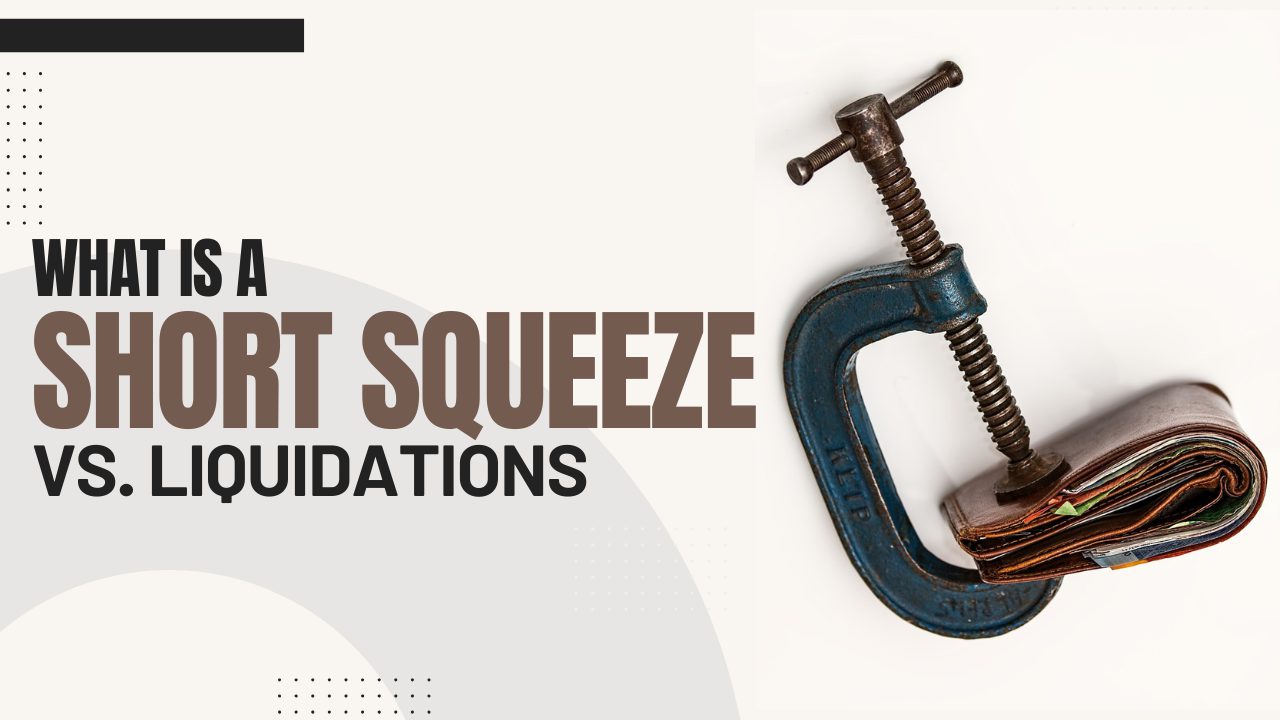
Short Squeeze is a term that’s often misused since 2021.
In this post, I’ll explain exactly what it means and how to correctly describe various market phenomena.
Let’s start with the basics:
What is Shorting?
Shorting or short selling is a strategy where a trader bets on an asset’s price going down.
In other words, when you “short” you make money when prices fall.
I’ll illustrate how it works under the hood with an example: let’s say you think the share price of a company will decline. Then:
- You borrow shares from your broker and sell them immediately – leaving you with (let’s say) $10k in cash and 100 shares of debt
- You wait for the price to fall – let’s say the stock drops 20% within the next month
- You buy shares at the lower price – spending $8k to buy back the 100 shares you owe
- You return the shares and the difference is your profit – $2k in this case, minus any interest on the borrowed amount
Of course, if the price increases, you’ll have to use your own money to buy back the shares at a higher price, resulting in a loss.
Note: when you long, your possible loss is limited to 100% (if the price goes to 0). But when you short, your loss is unlimited (proportional to the price increase).
What is a Short Squeeze?
A short squeeze is a rare phenomenon where there are not enough shares for short sellers to close their positions.
Of course, shares continuously change owners in the secondary market. But if nobody is selling at current market prices, short sellers have to bid higher and higher in order to acquire them.
Since short sellers have an obligation to repay the debt, in a short squeeze scenario, some may be forced to pay a multiple of their debt just to close it. Or continue holding, depositing collateral, and paying interest, while risking enduring further price increases.
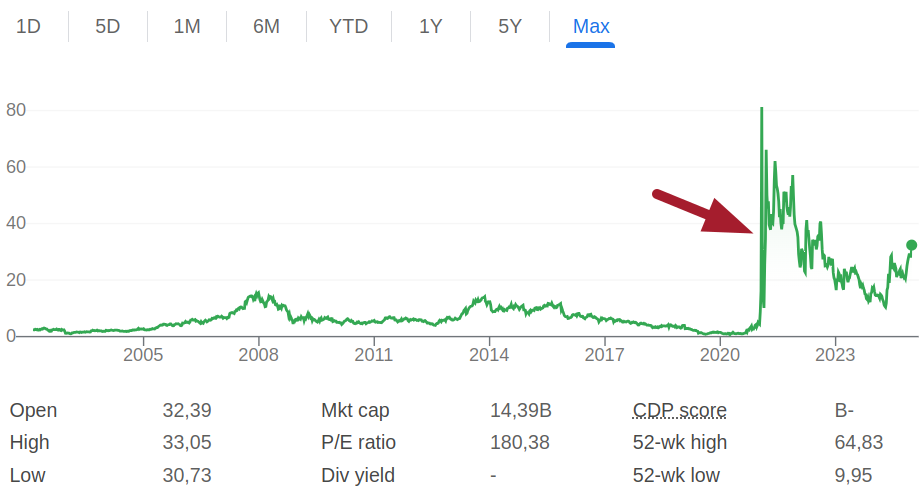
The term became popular during the short squeeze of GameStop stock (GME) in 2021.
After the pandemic, most market participants, primarily institutions, were betting on GameStop’s collapse. When it was revealed that the short interest (the amount of shares lent for shorting) exceeds the company’s public float (all shares available for public trading), a movement emerged on the r/WallStreetBets subrerddit, sworn to buy $GME and diamond hand (hold forever), not giving corporations the chance to cover their shorts (buy back borrowed shares to close out their loans).
Long story short, the price did a 15x within 2 weeks, short sellers were down bad, and some funds even went bust as a consequence.
Now, why did I name this post not everything is a short squeeze?
Because n00bs use the term “short squeeze” whenever they see sharp rise in prices.
That is false and misleading.
Actual short squeezes happen very rarely – when more than 100% of the shares are lent out (by brokers re-lending them). What many refer to is actually liquidations.
Liquidation of Shorts
Liquidations happen when you use leverage in a margin account and your balance is insufficient to keep your position open.
If you fall bellow the maintenance margin (a minimum balance that you have to maintain as a percentage of the debt), the broker will automatically close out your loan by liquidating your collateral.
So far, this is very similar with the short squeeze scenario. You either have to post more collateral or close your position at a loss (voluntary or forcibly).
Where they differ is that, in a liquidation, there is no scarcity of shares.
To use the correct terms: the short interest is not exceeding the public float.
So yes, forced liquidations affect share prices in a similar way as well. Especially reinforcing the direction during times of high volatility.
But nobody is getting squeezed. They’re “just” liquidated at market price.
And a PSA to end the post: in general, I don’t recommend using any type of leverage.
Author
-

D. Petkovski
📓 The Author Husband & Father
Software Engineer StrengthCentric
 ₿itcoin Hodler Long-Term Investor
🌍 Everything Enthusiast 🔥 Optimist

 Husband & Father
  Software Engineer


Related posts:
 Investment Taxes in ALL EU Countries (2024)
 Opportunity Cost With a Twist
 Recession Predictions vs Economists & the Media
 Sticking to a Strategy (Notes From the 2020 Recession)
 Inflation Explained
 Receive Tax Free Dividends in The Netherlands
 Dividend Investing is for Suckers!
 Asset Allocation – Finding Your Ideal Distribution
 Bitcoin Tax in All EU Countries (Capital Gains & Wealth Taxes) (2024)
 5 Steps to Overcome Investing Fear
 Market Order vs Limit Order – Placing Orders Tutorial
 Net-Worth Taxation in Europe (EU Wealth Taxes) (2024)
 Yield Conversion – HPY, EAY, BDY, MMY, BEY (Convert Easily)
 Market Cap vs Fully Diluted Valuation (FDV) – Explanation & Practical Analysis
 Sector Boost With QDVE For ETF Investors