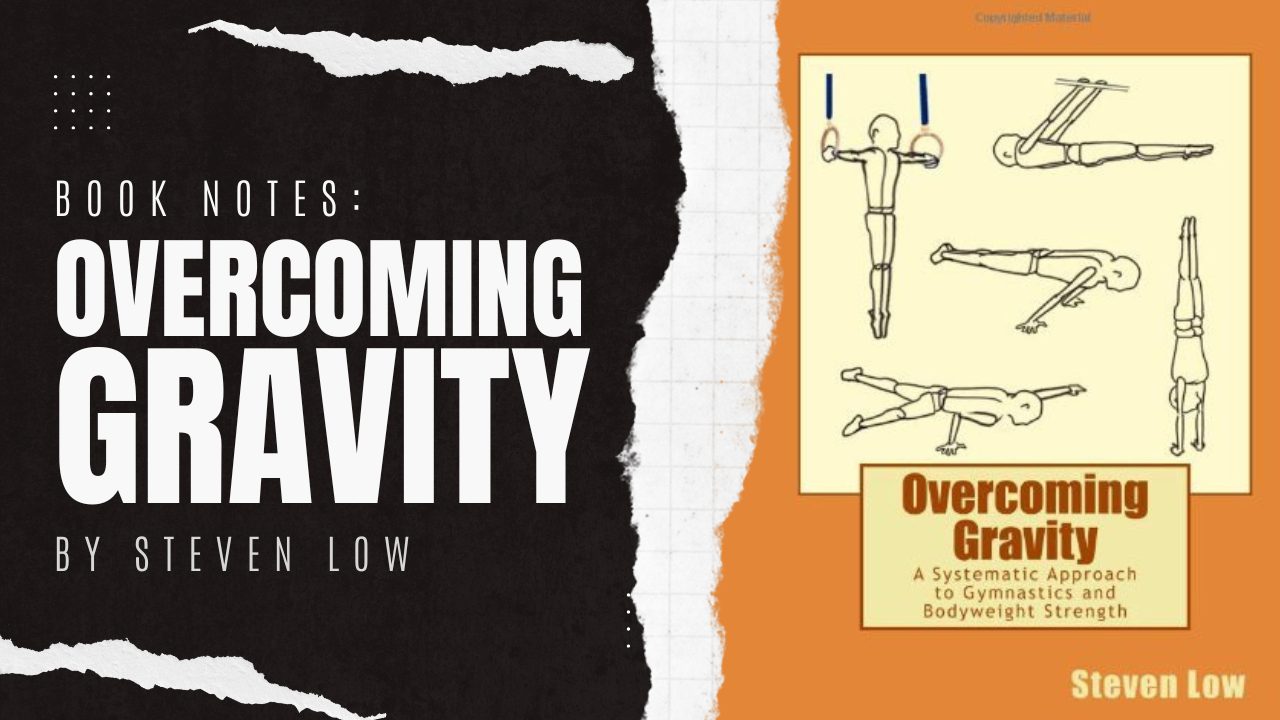
Overcoming Gravity: A Systematic Approach to Gymnastics and Bodyweight Strength by Steven Low is one of the best books on structuring a complete bodyweight training routine.
I love that it’s evidence-based, that it goes deep into various aspects of health and fitness, and doesn’t rush into presenting actual exercises or routines.
Of course, as the title suggests, the ultimate focus is on conquering gymnastics elements such as front levers, iron crosses, handstands, etc. But it still lays out a strong foundation for the reader, providing principles that can be applied to any type of training.
My Notes from “Overcoming Gravity” by Steven Low
Disclaimer #1: I’ve read the first edition of Overcoming Gravity a long time ago and I just stumbled upon my notes. They’re not a complete representation of the contents, but simply what was relevant for me relevant back then. I’ve read that the second edition is superior, so I’ll have it on my radar when I’m more serious about fitness again.
Disclaimer #2: this is a oversimplified and dense summary. It’s by no means a substitute for reading the book, but merely notes for myself so that I remember what’s in each chapter.
Disclaimer #3: Remember, I couldn’t articulate any of this as good as the author did, but I’m confident in my ability to draw straight-forward conclusions. However, this is my interpretation of what I read and I don’t claim that Steven Low meant the same.
Without further ado, enjoy this episode of book notes!
Chapter 1: Laying the Foundation
The core parameters of progressing with bodyweight training are levers and muscle length.
In summary, longer levers = more difficult and lengthening the muscles used = more difficult (think about bent arm vs strength arm movements).
There are two types of movements: OKC and CKC (open kinetic chain and closed kinetic chain).
OKC movements are those where the hands or feet can move freely in space (such as bicep curls or leg extensions) and they work best for rehabilitation, while CKC movements are those where the hands or feet are fixed (such as squats or pull ups) and are recommended for strength training.
Chapter 2: The Basics of Physiology of Strength
The difficulty of any exercise is inversely correlated with the number of reps an athlete can perform. The author covers ideal rep ranges when training for: strength, hypertrophy, endurance, or rehabilitation.
I write about this in more detail in my post on Calisthenics & Strength Training:
Strength and endurance are on the opposite sides of the rep spectrum – maximum strength is the ability to do a movement once, while maximum endurance is the ability to do a movement as many times as possible.
There are 3 types of muscle fibers: 1, 2a, and 2b.
- Type 1 are red and are mostly developed by sports that require endurance – they’re “slow twitch”, slow to fatigue, and play a smaller role in hypertrophy
- Type 2a are pink and they’re “adaptable” (i.e. having characteristics of both 1 and 2b), so the type of training will adapt these fibers towards strength or endurance
- Type 2b are white and they contract the fastest and also fatigue faster. These are the main fibers in strength-focused movements and have the most potential for hypertrophy.
A motor unit is a motor neuron and the fibers it innervates. There are two types of motor units: LTMUs (low threshold motor units) and HTMUs (high threshold motor units).
LTMUs correspond with type 1 muscle fibers (for “easy” movements, such as playing cards) while HTMUs correspond with type 2b fibers (for movements that require great force, such as a one arm pull up or a heavy deadlift). Recruiting the HTMUs also stimulates the LTMUs and this is best done by using “explosive” power.
The CNS (central nervous system) dictates the motor units’ activation and is crucial for improving an athlete’s strength.
Ideally, it should maximize the number of motor units recruited and minimize the time between activation of different muscles for a movement.
Theory aside, this is “easily” achieved through repetition of difficult movements in good form.
Note that after high-intensity sessions, the CNS needs proper recovery which is achieved through rest, food, and sleep. That’s why we program “deload weeks” (scaling down the intensity) before testing maximal strength.
Chapter 3: Setting and Achieving Goals
Determining training goals is very important when creating a routine. The goals should be specific, measurable, action-oriented, realistic, time and resource constrained.
This is also known as SMART goals and although in different industries the words behind the acronym might differ, the point is similar.
Various researches have shown that writing down goals and journaling one’s progress leads to improved consistency.
Chapter 4: Maintaining Structural Balance
Shoulder health is extremely important when creating a routine.
The shoulders are all-encompassing in upper body training as the hips are in lower body training.
Focusing on the shoulder, we can divide all exercise in three different ways:
- Primarily, we divide the movements into pulling and pushing exercises (for example rows vs. dips).
- Secondarily, we divide them into horizontal and vertical movements (for example military press vs. bench press).
- A third split is into exercises where the shoulder is in flexion and extension (meaning hands being in front of the body vs. behind the body).
The strength from exercises where the shoulder is in a certain “position” (defined by the three divides) has most carry-over to movements where the shoulder is in the same position.
An ideal routine should be balanced for each combination of these parameters.
There are lots of horizontal/vertical pushing exercises with the shoulders in flexion (push ups, dips, etc.). But the only pushing exercise in extension listed in the book is the V-sit / manna. Such movements are rarely included even in bodyweight routines, which often leads to imbalances, weak scapular retraction, and less developed rear deltoids.
Chapter 5: Skill and Strength Progression Charts
This is how the author recommends doing progressive overload when training for strength:
- For isometric exercises, proceed to a more difficult progression once we can do 6 second holds
- For dynamic exercises, proceed to a more difficult progression once we can do 3 reps
- For eccentric exercises (training the negative portion to gain strength for the concentric), proceed to a more difficult progression once we can control the full ROM (range of motion) for/longer than 3 seconds
This chapter also includes recommended exercises for various shoulder positions, but I will skip that part.
Chapter 6: The Basics of Hieararchy of a Routine
The order of the types of exercises should follow this format:
- Warm up
- Skill / technique training
- Strength training
- Endurance training
- Mobility / flexibility training
Skill training has to be done in perfect form or not at all. At the same time, it shouldn’t exhaust any muscles that would impact the main training. It’s a similar philosophy to warm up – and in many cases, those can be done simultaneously.
For the main training (strength), it’s recommended to start with negatives and isometrics and then dynamic exercises. We should be able to do at least 3 reps in the dynamic part, so make sure that the first movements are not completely exhausting. In case we’re doing additional isolation or hypertrophy work, we leave it for the end of this section.
Chapter 7: Structuring the Routine
A full body routine is superior to a split, especially for beginners.
For strength training, compound exercises are superior to isolation exercises.
To structure a routine, first pick goals from different categories (a push exercise, a vertical pulling exercise, a skill, etc.) and start with those that are primary goals, so you’re the strongest for them. Of course, don’t neglect any body part as a consequence of this.
Chapter 8: Programming
Periodization
Periodization is manipulation of training variables to optimize performance. It has 3 components: microcycle, mesocycle, and macrocycle.
- A microcycle is oriented towards training on a weekly time frame
- A mesocycle is a collection of 4-8 microcycles and can have a diverse structure, for example: a microcycle for preparation, for hypertrophy, for strength / power, and one for recovery.
- A macrocycle is a collection of mesocycles that are organized in a way so that the athlete is in best shape after finishing the last one.
The mesocycles are the primary focus when building a training program.
Intensity
The 3 types of movements we’re working with are: dynamic, isometric (static), and eccentric (the negative portion of the movement).
The dynamic movements are performed relatively fast, while the eccentric should be performed slow and controlled.
In comparison to dynamic movements, an isometric contraction is 100-120% stronger and the eccentric is 100-150% stronger (for example, if you can lift 30kg in some exercise, you’d be able to hold the peak contraction with even more weight, and be able to do the negative portion with even more).
We can organize the sets and reps according to the Prilepin’s chart – based on the relative difficulty of the exercises as a percentage of our 1RM (one rep max).
- For dynamic exercises, the recommendation is 3 sets of 3-8 reps of 80-93% of your maximum
- For isometric exercises, it’s best to do 4-5 sets for 70% of your maximum hold time
- And for negatives, also 4-5 sets, but the recommended intensity is 50-60% because the negatives are more taxing both on the muscles and the CNS
Rest
An optimal time between two training sessions, so that in the second you can see the effects of the first one, is 2-3 days.
If the primary focus is strength, we should rest as much as necessary to be fresh for the next set (around 3-5 minutes). Under 3 minutes is more suitable for a hypertrophy oriented program.
If we’re tight on time, we can pair exercises that don’t affect the same primary muscles (for example, a push and a pull exercise), and do them one after the other. This effectively can halve our training time.
Greasing the Groove
GTG (greasing the groove) is a method that involves practicing a certain movement often, at various times during the day.
The primary goal of GTG is CNS adaptation, but it can also help with increasing the number of reps or hold time, or mastering a skill.
Greasing the groove is practiced outside of the training program, with lower-intensity sets done throughout the day. For example, doing a set in every 2-3 hours, with 60-80% of the reps/intensity you use in actual training.
For calisthenics static holds, the author says it works good for front lever and back lever, but not with planche. I can confirm this from personal experience.
Chapter 9: Programming and Advancing
Beginner Level
Beginners should train 3 times per week and continue conquering higher progressions as long as they see linear progress (every training session is better than the previous one).
They can choose a day out of those three for strength testing and decide whether to proceed to a next progression based on it.
The author recommends to pay special attention to the mobility/flexibility of the joints and legs, as these will be important in more advanced movements later on.
There are two options to conclude a training cycle for beginners: if there’s no progress in any of the exercises for more than a week or after 4-8 weeks.
Intermediate Level
In this level, an athlete is working on perfecting a handstand, freestanding HSPUs, press to handstand, front lever, back lever, straddle planche, etc. This level is achievable after 12-18 months of being a beginner.
The recommendation is to add a fourth day of training and each training session to have 2 pushing exercises and 2 pulling exercises.
The progress at this level should be visible week over week. If there’s no progress for 4 weeks or so, then it’s recommended to wrap up the cycle and come back stronger after a recovery week.
Advanced Level
At the advanced level, the consistency stops being the primary factor for progress and it’s necessary to incorporate periodization. Progress is usually visible only after a mesocycle.
There are great tips and recommendations for advanced athletes, but I’ll skip sharing my notes as it can make this post even more complex than it already is. For the curious, check out the concept of DUP (daily undulating periodization).
Chapter 10: A Brief Look at Overreaching and Overtraining
It’s okay to overreach sometimes, especially if it’s planned. But if you push too far, you may “overtrain”.
Overtaining is the inability of the body to recover fast enough, so you need more time to rest than initially planned to come back to your training schedule.
Definitely something to be avoided, as apart from hindering progress, it can also lead to injuries.
Chapter 11: Cross Training and Cardio
If you do other sports besides bodyweight training and they were a priority, they should remain a priority.
However, if you do both types of training every day, you may overtrain. But if you split them evenly throughout the week, the progress may be subpar. If the sport is a priority, more days should be dedicated to it, unless the athlete is capable to balance both in the same day without hindering progress.
The aerobic base is the foundation of your cardiovascular fitness. The analogy is a reservoir – the larger it is, the more you can utilize it. It can be built in any way (running, swimming, biking, etc.), but the performance in different disciplines don’t necessarily carry over. A proficient runner may be exhausted after a 5 minute round on a BJJ open mat.
For strength-based athletes that don’t do other sports, an “easy” cardiovascular activity 2-3 times per week of 10-20 minutes each, is sufficient. This may be running, shadow boxing, jumping rope, or things like that.
It’s definitely not necessary, but it can help with recovery once an athlete is more advanced and the intensity of the exercises increases.
Chapters 12-18 and Appendices
The post is already long enough, so I’ll stop here.
The next chapters in the book cover injuries, injury prevention, recovery, (p)rehabilitation, working out while sick, lifestyle factors (age, diet, sleep), etc.
The last part has amazing reference materials and detailed explanation of progressions for various bodyweight exercises (from push ups to iron crosses, front levers, and planches).
I recommend taking a look yourself if you’re serious about bodyweight training.
Besides that, you can also read about My Approach to Calisthenics & Strength Training.
Author
-

D. Petkovski
📓 The Author Husband & Father
Software Engineer StrengthCentric
 ₿itcoin Hodler Long-Term Investor
🌍 Everything Enthusiast 🔥 Optimist

 Husband & Father
  Software Engineer


Related posts:
 Overcoming Unwanted Intrusive Thoughts by Sally M. Winston & Martin N. Seif (Book Notes)
 The Power of Now by Eckhart Tolle (Book Notes)
 Show Your Work by Austin Kleon (Book Notes)
 The Art of War by Sun Tzu (Book Notes)
 Meditations by Marcus Aurelius – Book Notes
 The Four Agreements by Don Miguel Ruiz – Book Notes
 Counsels and Maxims by Arthur Schopenhauer (Book Notes)
 Sticking to a Strategy (Notes From the 2020 Recession)
 SGA Preterm Baby – 6 Months Progress
 5 Money Myths and Misconceptions
 Luxury is Subjective – The Cultural Bias in Status Symbols
 My Approach to Calisthenics & Strength Training
 Real Diversification – Banks, Passports, Residencies, Driving Licences, Assets
 I Bought an Apartment in Dubai with Crypto
 What is “Rich”? A Discussion on Hard Money & Lifestyle